
CHAMBERS IN ACTION
Local chambers across the country are taking the lead in creating and convening clean energy conversations, best practices, events and advocating on local policy.

Georgia Chamber names EV manufacturer 'Coolest Thing' contest winner
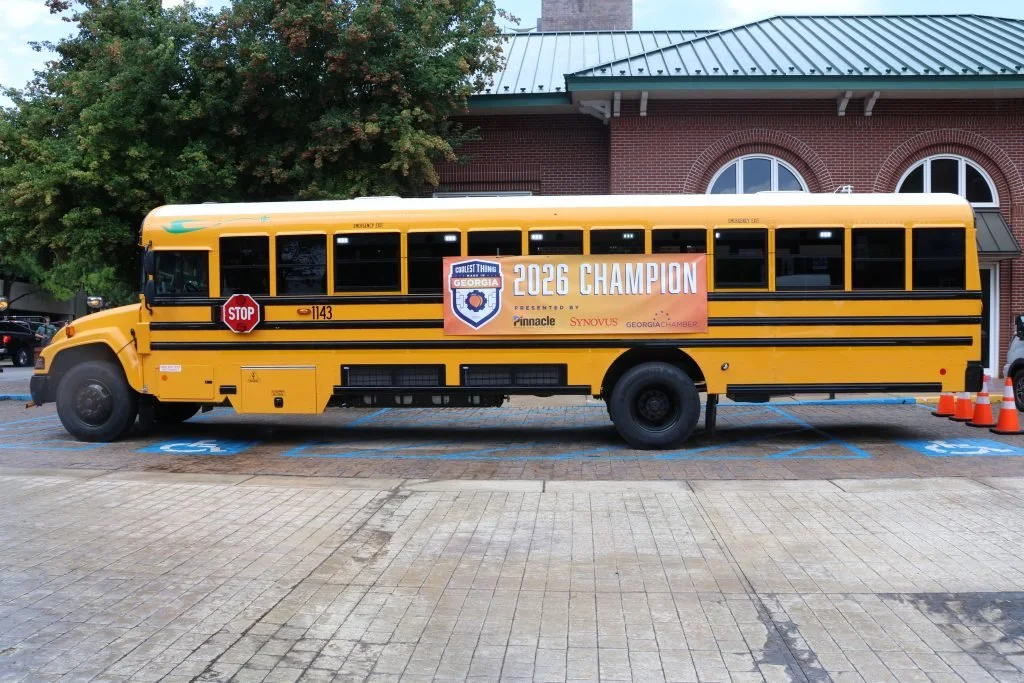
The Coolest Thing Made in Georgia is an electric school bus. The Blue Bird Vision Electric school bus took top honors in the Georgia Chamber of Commerce’s 2026 Coolest Thing Made in Georgia competition, a statewide, public vote celebrating the products, manufacturers, and innovation that call Georgia home. The Georgia Chamber announced the winner at its Congressional Luncheon in Athens.
“Georgia is home to innovative companies and products that are making an impact far beyond our state’s borders,” said Chris Clark, president and CEO of the Georgia Chamber. “The Blue Bird Vision Electric School Bus represents the ingenuity and manufacturing excellence that make Georgia a global leader in business. Congratulations to Blue Bird on this achievement and on its nearly century-long legacy of creating innovative products right here in Georgia.”
The recognition is yet another example of how chambers can celebrate the companies and technologies shaping their states’ economic future and help connect clean energy growth to jobs, investment, and local economic opportunity.
Founded in 1927, Blue Bird builds the Vision Electric school bus in Fort Valley, where it has operated as a Georgia business for nearly 100 years. The company employs more than 1,500 people at its Fort Valley manufacturing facility, and more than 4,000 Blue Bird Electric school buses are already operating across the United States.

The electric bus also highlights Georgia’s growing leadership in clean energy and advanced manufacturing. State leaders have called Georgia the “buckle of the battery belt,” as investment in electric vehicles, batteries, and related manufacturing has brought new businesses and jobs to communities across the state. Blue Bird provides a homegrown example of what that leadership can mean for local communities.
And there is still room to grow. Recent reporting found that while Georgia ranks seventh nationally in EV charging infrastructure, Central Georgia lags other parts of the state. The contrast underscores the opportunity for chambers and economic development organizations to lead: helping their communities understand where the economy is headed, celebrating the businesses already driving that growth, and positioning their regions to capture the jobs and investment that come with it.
By putting a Fort Valley-made electric school bus in the statewide spotlight, the Georgia Chamber is helping show that clean energy innovation is already part of Georgia’s manufacturing story.
“We’d like to thank the Georgia Chamber and all of the voters for being named ‘The Coolest Thing Made in Georgia’ for our zero-emissions electric school bus,” said John Wyskiel, president and CEO of Blue Bird Corporation. “This recognition reflects years of innovation, dedication and a shared belief that student transportation can be safer, cleaner and, yes, apparently cooler than we ever imagined.”
Hosting an awards ceremony or creating a public recognition platform to recognize the proactive work of your members and community groups is an easy way to further clean energy adoption. For more examples of successful awards programs, check out CICE’s Toolkit.

Blackstone Chamber of Commerce Supports Approval of Rocky Ford Solar Project

Nottoway, Virginia County Courthouse
In April 2026, the Nottoway County (VA) Board of Supervisors approved the 100-MW Rocky Ford Solar Project following strong support from the local business community. The Blackstone Chamber of Commerce played a leading role in making the business case with support from Chambers for Innovation and Clean Energy (CICE).
Communities across Virginia continue to look for economic development opportunities that create jobs and strengthen local finances without placing additional pressure on critical local infrastructure. For the Blackstone Chamber, the Rocky Ford Solar Project represented exactly that kind of investment, one that would generate new revenue, support local businesses, and contribute to the county’s long-term economic health.
The Blackstone Chamber helped elevate the business community’s voice throughout the zoning process. In a piece submitted to The Courier-Record, “Rocky Ford Solar Is Right Kind of Growth,” Chamber Chairman Chris Page described the project as “the right kind of growth” for Nottoway County, emphasizing its projected economic benefits and long-term value to local residents and businesses.
During the construction period alone, local economic output is estimated at $18.7 million, supporting restaurants, contractors, and services across the region. Over the project’s 40-year life span, the site is projected to generate roughly 40 times the revenue it would produce under its current use, creating a lasting source of economic value for the county.
To support the Blackstone Chamber’s efforts, CICE provided resources to the chamber’s members and local stakeholders illustrating how utility-scale solar projects can benefit host communities. CICE’s Energizing Economies Cohort Chair, Josh Bass, submitted comments to the Board of Supervisors and contributed an opinion piece, “Solar could boost local economy,” to The Courier-Record outlining the project’s broader economic ripple effects.
“That influx of activity can make a real difference by giving businesses the breathing room they need to reinvest and grow. It helps the restaurant owner replace aging kitchen equipment, the hotel upgrade rooms to stay competitive, and the barber shop bring on that extra employee," Bass wrote.
Bass’ comments were also read during a public hearing by a community member, ensuring the economic case for the project was shared directly with county leaders and residents. During the final public hearing, CICE’s Bryan Fox also spoke in support of the project and highlighted the benefits responsible solar investments can deliver.
“As head of the Blackstone Chamber of Commerce, I spend a lot of time thinking about the ‘ideal’ type of economic development for our community. We want projects that build our tax base, support our local shops, and create good jobs, all without overcrowding our classrooms or straining county services. The proposed Rocky Ford Solar Project is a rare example of a development that checks every one of those boxes,” said Page. “It’s the kind of growth that makes sense for rural Virginia.”
The Key Takeaway
The approval of the Rocky Ford Solar Project demonstrates the important role chambers can play in shaping local economic development conversations and elevating the perspectives of the members they represent. By bringing forward an economic case for clean energy and engaging in the process, the Blackstone Chamber helped secure an investment that has the potential to transform the local economy.
Other chambers and economic development organizations may look to this effort as an example of how strategic partnerships and consistent local engagement can support successful project outcomes. CICE can support chambers as they evaluate clean energy opportunities in their communities.

McLean County Chamber Connects Rivian to Workforce Solutions
Rivian representatives came to the Normal, Illinois area to bid on equipment from Mitsubishi Motors' shuttered plant but conversations they overheard at a local coffee shop made them stay.
Mitsubishi shuttered the facility in 2015, leaving behind a massive plant, idle equipment, and more than 1,000 unemployed workers.
Drawn in by the people and the area’s amenities, including an airport, rail lines, and Illinois State University’s 20,000-plus students, the Rivian reps called CEO Robert J. “RJ” Scaringe and said, in effect, “This could be home,” according to Charlie Moore, president and CEO of McLean County Chamber of Commerce.
Rivian’s senior leadership engaged early on with the five-star accredited, 1,000-member chamber on workforce priorities. Displaced Mitsubishi workers provided a ready manufacturing workforce.
“The secret sauce is your people,” Moore told CICE. “As a chamber, that’s one of the things we can do: be a connector. We probably don’t know the answer, but we probably know who does. I end every conversation the same way: ‘How can I help you?’”
The region’s educational institutions, including Bloomington Career Academy, Heartland Community College’s new advanced manufacturing center, and Illinois State University’s newly launched College of Engineering, have built curricula around Rivian’s hiring needs, according to Moore.
Rivian opened its production line for the R2 this spring. In addition, Rivian partnered with Redwood Materials to deploy a 10-MWh battery energy storage system at its Normal manufacturing facility, repurposing more than 100 second-life Rivian battery packs to lower costs and strengthen grid reliability during peak demand.
Rivian and Uber also announced a partnership in March 2026 to deploy 10,000 fully autonomous R2 robotaxis, beginning in San Francisco and Miami in 2028 and expanding to 25 cities by 2031.
Chamber aligns schools with workforce needs
Today, Moore said, the chamber is leading a broader talent alignment strategy, convening the area’s largest employers, including State Farm, Ferrero, Bridgestone Americas Tire Operations, and Rivian, alongside educators to answer three questions:
Where are the workforce gaps?
Are we closing them?
Who is responsible for closing them?
For chambers and EDOs interested in attracting clean energy investment and manufacturers, Moore’s advice also comes down to three things:
Let your economic development partners lead on incentives.
Support elected officials who are willing to, as Moore said, "take some arrows" for smart risks.
Lean into the chamber's role as a connector.
Watch Moore’s full conversation with CICE about the McLean County Chamber of Commerce and Rivian.

San Angelo Chamber is Advancing a New Energy Economy in Texas
Michael Looney, vice president of economic development at the San Angelo Chamber of Commerce, and his leadership team recruited multiple 200-400 MW energy projects to the region surrounding the West Texas city of approximately 100,000 residents.
“The chamber wanted to explore ways we could encourage and directly support the development of renewable energy production facilities that would bolster our economy, create new kinds of technical career opportunities, and allow our county to participate in the provision of electrical energy to the Texas power grid,” said Looney.
In 2015, Looney and his chamber team embarked on achieving two priority goals:
To diversify the San Angelo economy into clean energy development and position the San Angelo Chamber as a national leader in that sector.
Equally important: To lead this new initiative with transparency and open communication, provide the community with reliable information.
Looney and his team successfully recruited 1.2 GW of electric generation within the San Angelo and Tom Green County borders, accomplishing the chamber’s economic and job creation goals. These projects include four utility-scale solar power plants and one 200-MW battery energy storage system.

San Angelo Chamber of Commerce Vice President of Economic Development Michael Looney on Capitol Hill
“We believe the San Angelo Chamber of Commerce has become one of the strongest proponents of clean energy development in the United States. The chamber is now a catalyst and headquarters for renewable energy development, not just in our county, but across a five-county region known geographically as the Concho Valley,” Looney said. “We have led by example. We have attracted renewable energy developments in wind, solar, and battery energy storage from Canada, the United States, Israel and South Korea. Our clean energy initiatives have successfully complemented our thriving oil and natural gas development services sectors as well. At all levels, our renewable and O&G companies work well together in the area, and in one instance, a national O&G company directly invested in 50% of one of our solar power plants.”
San Angelo’s energy economy continues to diversify beyond new clean energy generation. The Chamber helped land a solar panel recycler for its community and developed a new, privately-owned 184-acre rail port, designed in part to accept wind turbine nacelles and blades for transloading to final regional destinations.
Looney joined CICE for its April 2026 D.C. Fly-In with other chamber and economic development leaders, taking full advantage of the opportunity to share with lawmakers how clean energy powers the San Angelo area’s economy. Whether working with the business community, local, state or federal elected officials, educational leaders or residents, Looney is building bridges to advance a strong clean energy economy and future for his community.
“Clean energy is not a political stance. It is an innovative, cost-effective, efficient and durable method of power generation, which in turn reduces the pressure on other industries that are solely reliant on fossil fuels. We’re excited about our success in the clean energy sector, and to continue our mission to lead the way,” said Looney.