
CHAMBERS IN ACTION
Local chambers across the country are taking the lead in creating and convening clean energy conversations, best practices, events and advocating on local policy.

Beep-Freebee Merger Fuels Florida's Economy
Clean Transportation Innovators Expand Through Chamber Involvement
Two leaders in autonomous and electric public transportation, Orlando-based Beep and Miami-based Freebee, merged in September, creating a national powerhouse in the industry.The merger shows how investments in clean, innovative technologies can expand Florida’s economy and how chambers of commerce help them grow. After all, the combined company will operate in more than 60 communities, serve more than two million riders each year, and employ nearly 1,000 people. Its headquarters will be Lake Nona, a major innovation hub east of Orlando.
“The Beep and Freebee merger is a great example of the kind of growth we want to see coming out of the Lake Nona ecosystem,” said Ashley Loute, executive director of the Lake Nona Regional Chamber of Commerce. “Beep has built and tested innovative mobility solutions here in Lake Nona, and today that work is scaling into a company serving communities across the country.”
Shortly before announcing the merger, Beep closed another investment round, bringing total capital raised to about $130 million.
Loute added that when companies headquartered in Lake Nona attract investment, create jobs and expand their reach, it strengthens the community’s reputation as a place where innovation becomes a real-world impact.
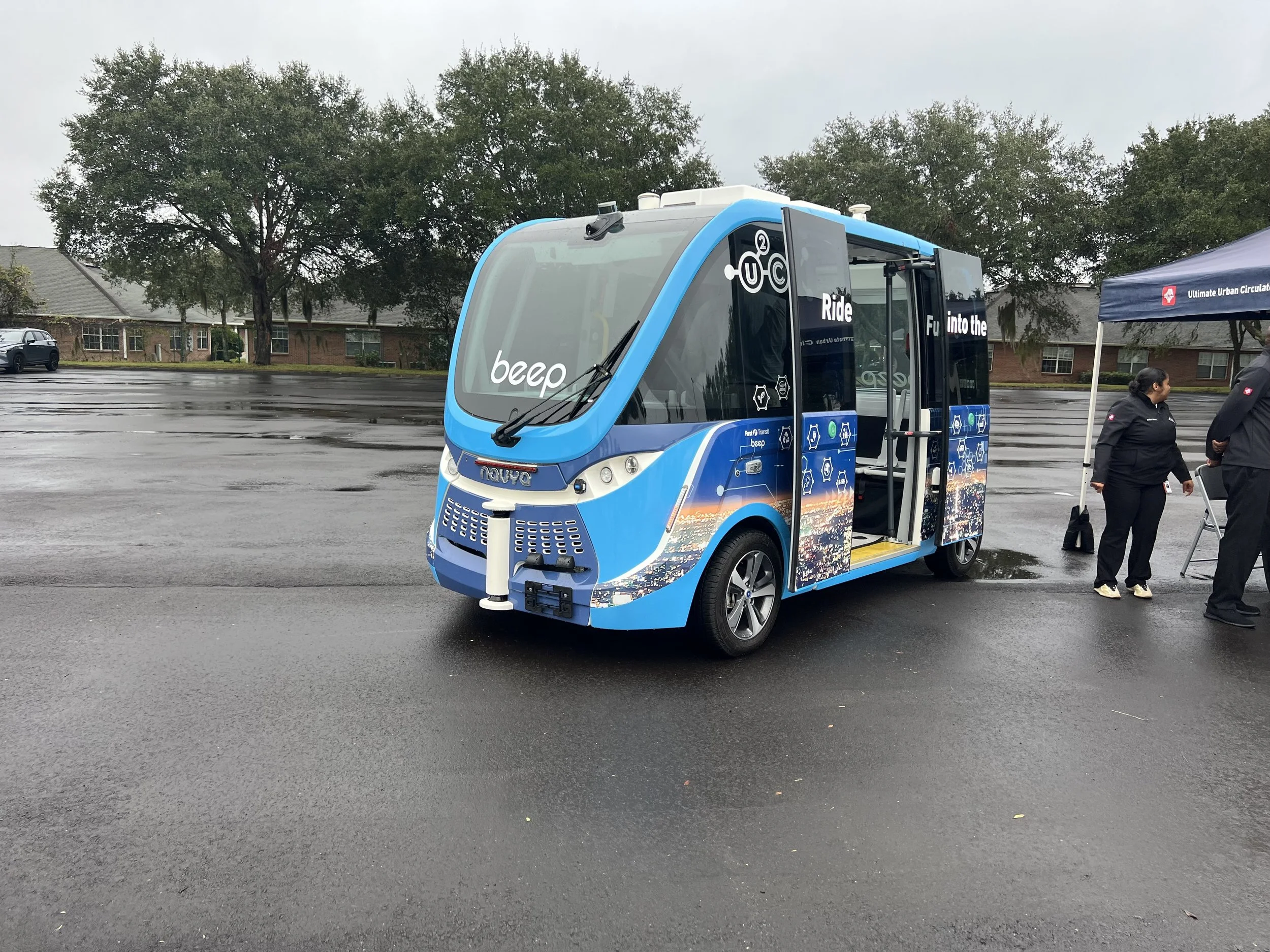
Both companies are leading a shift in how local governments can reduce the use of diesel buses and other gas-fueled systems.
Freebee shows another side of that transition by putting electric vehicles into public transportation systems people use every day. Beep demonstrates how communities use autonomous transportation to connect their population and commercial centers.
Together, the companies can now combine electric microtransit with autonomous technology at a much larger scale. With diesel costs skyrocketing, this is even more important today.
Since their inception, Beep and Freebee both have made local chambers part of their growth. Beep is a Business Builder member of the Lake Nona Regional Chamber, where co-founder Mark Reid serves on the board. It’s also a bronze member of the JAX Chamber in Jacksonville, another market where the company deploys its technology.
Freebee is a Trustee of the Coral Gables Chamber of Commerce. In Miami Beach, Gus Doyle, Freebee’s business development executive, serves on the chamber’s board. In Seminole County, where Freebee operates the new all-electric SCOUT public transportation system, the company sponsors the Seminole County Chamber’s monthly Good Morning Seminole breakfast.
Clean energy and transportation companies have a lot to gain by joining their local chamber. Membership connects companies deploying new technologies with the businesses, local governments and community leaders who make decisions about economic development, infrastructure and growth.
Both companies have participated in CICE conversations with Florida chamber leaders. Racquel Asa, Beep’s then- chief marketing officer, joined a CICE clean energy panel at a Florida Association of Chamber Professionals (FACP) conference. She discussed autonomous transportation, electrification, and the workforce needed to support those technologies
Freebee Vice President of Economic Development John Janusz spoke at a recent CICE panel discussion at FACP. He also participated in a CICE-moderated Seminole County Chamber discussion focused on SCOUT and how electric microtransit can expand transportation options.
In October, Lake Nona Regional Chamber members will get an even closer look when Beep hosts the Chamber’s Business After Hours at its Lake Nona headquarters, continuing its close ties with the chambers it supports.

Seminole County Chamber Puts Energy on the Congressional Agenda
Anyone running a business understands that rising energy costs are an issue, and business leaders in Seminole County, Florida, wanted to know what their congressional candidates planned to do about them.
At a recent Seminole County Chamber congressional candidate forum, seven candidates running in the primary for Florida's 7th Congressional District were asked, “How can the federal government stabilize rising energy costs and reduce dependence on foreign oil, particularly through renewables and energy storage?”
Energy has always been a business issue. The Seminole County Chamber’s forum showed how affordability, reliability, and rising demand are quickly pushing it up the agenda.
It makes sense because energy costs are business costs. Reliability affects existing employers and a community's ability to recruit new ones. Growing communities will need additional generation and infrastructure to support new residents, manufacturers, data centers, and other economic development.
Seminole County Shows How a Candidate Forum’s Done
The forum's structure highlighted important issues for business owners and executives. Three moderators participated in the forum, all local business owners or executives. Each received four questions in advance, with the expectation that time would allow for each moderator to ask only two. Energy was one of the first questions selected.
The chamber event also showed why an all-of-the-above approach can work for chambers. They can discuss nuclear, natural gas, renewables, storage, and other resources related to affordability, reliability, and future demand without requiring a chamber to approach energy through a partisan lens.
For the Seminole County Chamber, the conversation around clean energy isn’t new. The chamber has included energy in its programming through its work with Chambers for Innovation and Clean Energy (CICE). In 2025, the chamber held a forum on energy and transportation. It offers free EV chargers for its members and has testified on statewide charger policies. It also joined CICE in Washington, D.C., for a fly-in to push for permitting reform.
While other chambers may not be as engaged in energy issues as the Seminole County Chamber, this shows why energy is an important topic at candidate forums and should be included in legislative agendas.
Questions about energy costs, generation, reliability, resilience, permitting, and infrastructure can help members understand where candidates stand and help chambers determine where energy fits into their own advocacy work.
For your next candidate forum or questionnaire, check out CICE’s guide, Questions for Candidates: Clean Energy.

Chamber Leader, Miller Electric Company - Getting the Jump on Electrifying Transportation
|

|

|
|
|
|
|
|
|

|
